
If you arrive at the Musée d’Orsay to see the John Singer Sargent exhibition and find the line outside to be blocks long and the show jammed with art lovers, head instead for a sweet little show on the fifth floor, “Bridget Riley: Starting Point.”
Born in 1931, the British artist is known for her purely abstract, highly schematic paintings, totally devoid of figuration. Almost Escher-like, they are more interested in the effects they create in the eye of the viewer than in representation or beauty, although that is not to say that they are not beautiful.
The Orsay exhibition explores her surprising – given the nonfigurative nature of her œuvre – early fascination with the work of Georges Seurat (1859-91), the French Post- and Neoimpressionist artist best known for his Pointillist painting “A Sunday Afternoon on the Island of La Grande Jatte” (1884-86) and for his research on and experiments with color and light.

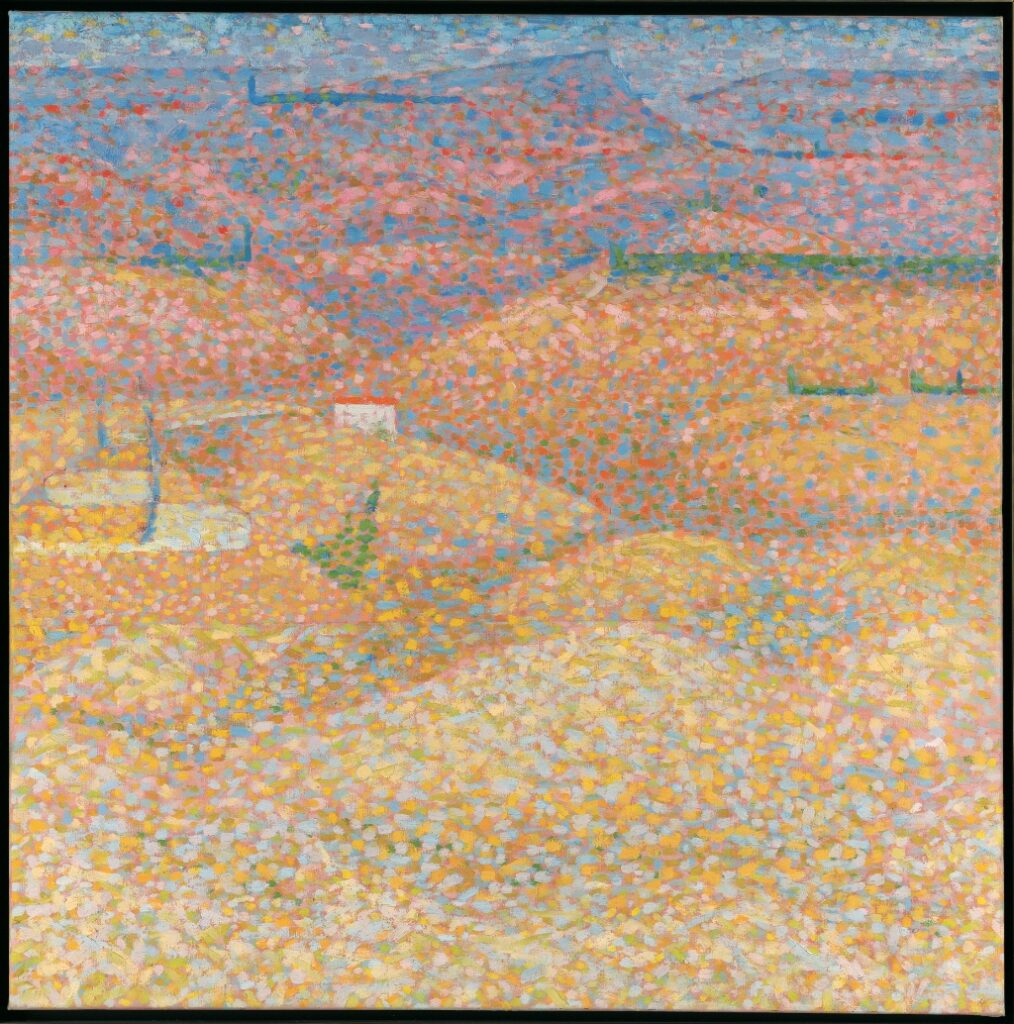
When she was 18 years old, Riley was struck by Seurat’s use of color in his painting “Bathers at Asnières” when she saw it in London’s National Gallery. Later, as a young artist struggling with the use of color and light, she painted a copy of Seurat’s “The Bridge at Courbevoie” (c. 1886-87) from a reproduction in a book in an attempt to learn more about how he created his effects. Testifying to the painting’s influence on her is the fact that she still has that copy hanging in her studio.
“Seurat helped me,” says Riley. “He and I share the same concern for perception and love of contrasts in painting. From his work, I learned something about the interrelationship of color and tone as well as the advantages and limits of a strictly methodical approach.”
The exhibition juxtaposes works by Seurat with pieces by Riley, including that early copy of “The Bridge at Courbevoie” and other works that imitate his style, as well as a number of pieces that are more recognizably “Bridget Riley.”

The show presents Riley “in a different light: as a vibrant Divisionist, even a modern-day Postimpressionist,” say the curators. Riley’s abstract works here echo the hues in the Seurat paintings and demonstrate how the interaction of different colors can produce the impression of other colors through the vibrations created by their proximity.

A feeling of peace emanates from Seurat’s paintings and his wonderful drawings in Conté crayon on show here, but I must admit that I was immune to the effects in many of Riley’s paintings of bands of contiguous colors, with one major exception: the painting “Cataract 2” (1967), whose undulating red, white and blue lines create the illusion of three dimensionality and of waves rolling inexorably over an imagined sea as you walk slowly toward it or back away from it.
After seeing this show, have a wander through the adjacent Postimpressionist rooms to look at the works by Paul Gaugin, Odilon Redon and the Nabi painters. Together, they make for a relaxing and pleasing visit to the museum. The Sargent show is a must-see, of course, but you can always return to visit it later when you have the courage to confront the crowds.
See our list of Current & Upcoming Exhibitions to find out what else is happening in the Paris art world.
Favorite