
French museums are brilliant at putting on mega exhibitions like the current “1925-2025: 100 Years of Art Deco” (through April 26) at the Musée des Arts Décoratifs or “Sargent: Dazzling Paris” (through January 11) at the Musée d’Orsay, both of which I have seen and can recommend, or “Les Gens de Paris” at the Musée Carnavalet (reviewed here), but every once in a while, it’s a real pleasure to see a smaller exhibition that excels and informs without taking up hours of your day. Two new shows at the Grand Palais fill the bill perfectly: “Eva Jospin: Grottesco” and “Claire Tabouret: D’un Seul Souffle.”
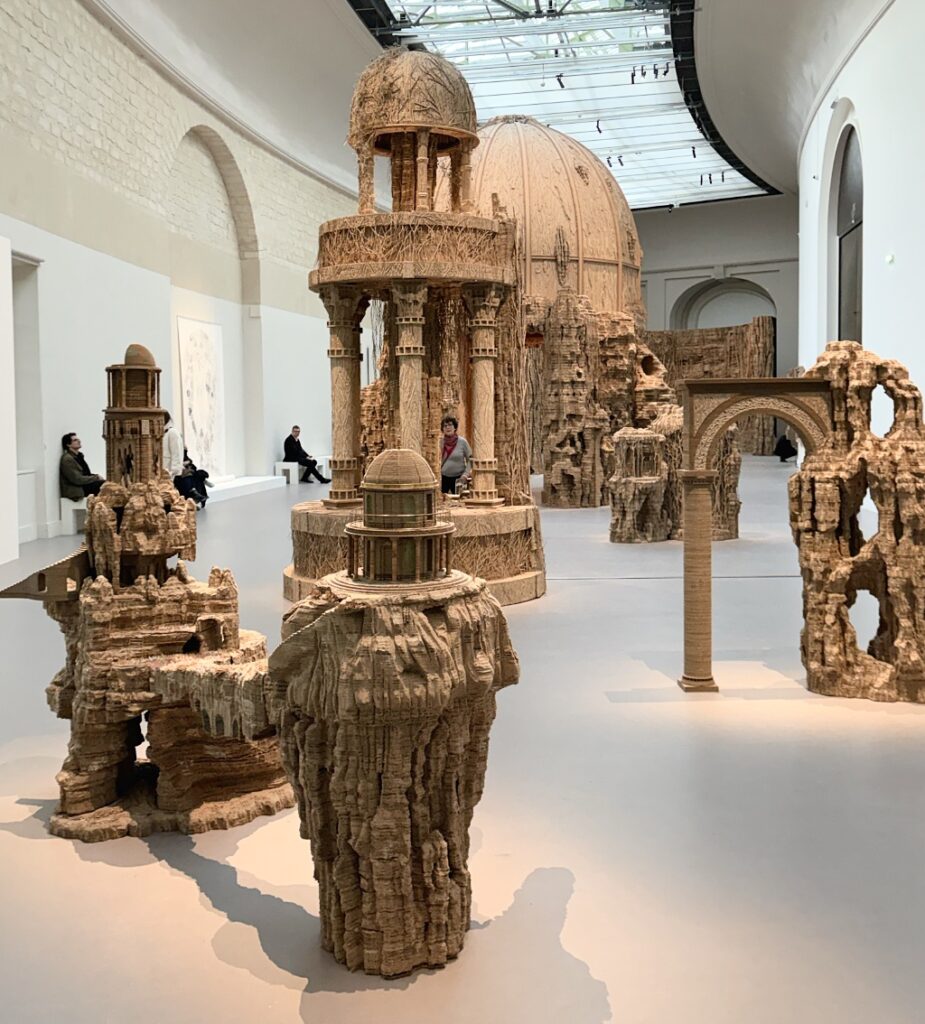
I have never seen a show of Jospin’s work that I didn’t love. The daughter of former French Prime Minister Lionel Jospin, she well deserves her art-world cred, working with humble materials like cardboard, twigs and branches to make beautiful, delicate, sophisticated structures. The current exhibition was inspired by the story of a young Roman who in the late-15th century tumbled into a hole in the ground and thus accidentally rediscovered the grotesque frescoes in the Domus Aurea, the long-buried palace of Emperor Nero, the despised first-century emperor of Rome. The rediscovered grottesco style inspired many Renaissance artists, including Raphael and Michelangelo, who descended underground to see them.
Jospin’s installation attempts to recreate the magic of that moment of discovery with precise architectural forms that seem to be in the process of being engulfed by nature. All are in the neutral color of cardboard, with the exception of some multicolored, delicately embroidered pieces.
One domed walk-in structure resembles the Pantheon in Rome, with a circular opening in the ceiling, and has much of the mysterious feeling of that building.
Jospin does not stint on detail, even in monumental pieces like the “pantheon” or the grotto-like structure at the end of the show. Look closely at each piece to make your own discoveries: an incrustation of seashells, for example, or a border of vines decorating these intricate structures, all of them totally devoid of signs of human or animal presences.
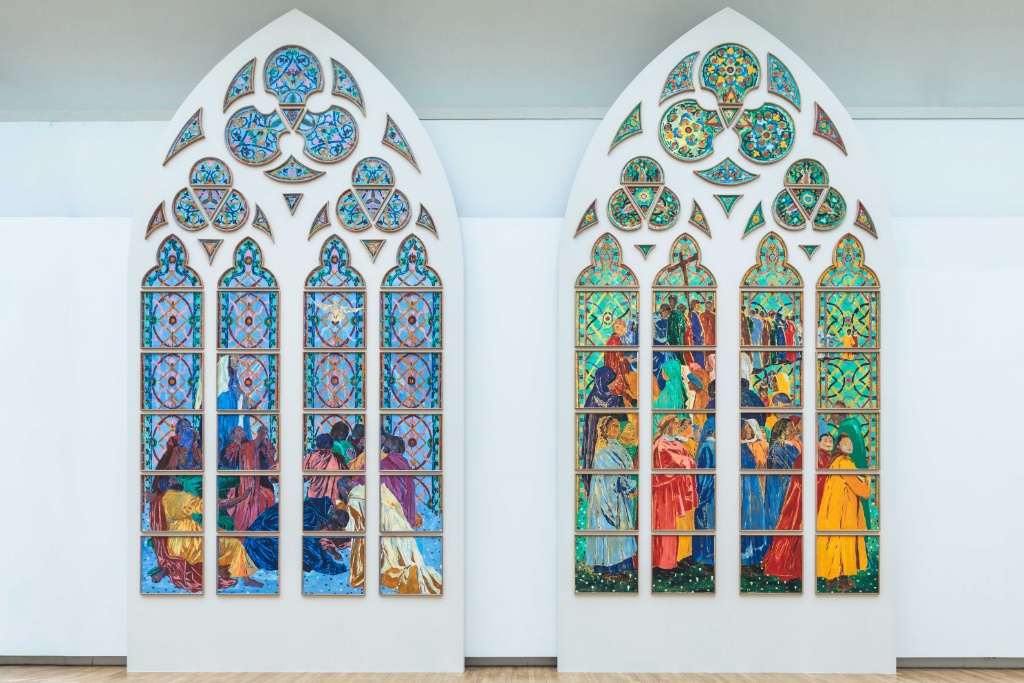
Contrasting nicely with the pagan theme of Jospin’s exhibition is Claire Tabouret’s complementary show with a very Christian focus. Tabouret is the artist who was chosen to design six new stained-glass windows for the revamped Notre Dame Cathedral. The theme imposed by the archbishop of Paris was Pentecost, the moment 50 days after Christ’s resurrection when his apostles were said to be visited by the Holy Spirit in the form of tongues of flame.
The artist used the monotype technique to make life-sized models of the windows, which are on display in the exhibition along with sketches and other preparatory works.The lovely images, bursting with bright colors, as befits stained glass, are surprisingly figurative and descriptive for contemporary works, each one illustrating a phrase from the Bible, e.g., “”There came from heaven a sound like a mighty rushing wind,” or “They were all filled with the Holy Spirit.”
Tabouret’s windows, now being manufactured by the Atelier Simon-Marq workshop, will be installed in the south aisle of the cathedral’s nave at the end of 2027. They will replace simpler, purely decorative windows that were mounted in the cathedral during architect Eugène Viollet-le-Duc’s 19th-century restoration. The decision to replace them, made by President Emmanuel Macron himself, caused an uproar among conservationists who see it as heresy to replace the undamaged windows.
Tabouret herself points to Parisians’ initial negative reactions to now-beloved projects like I.M. Pei’s Louvre Pyramid and Daniel Buren’s striped columns in the Palais Royal. She describes her designs, which retain some of the outgoing windows’ geometric patterns, as “very cautious, very gentle, harmonious.”
That they are. Go see for yourself.
See our list of Current & Upcoming Exhibitions to find out what else is happening in the Paris art world.
Favorite