
I decided to go see Hamlet: #La Fin d’une Enfance, an updated version of Shakespeare’s play, with some trepidation, as so many modern rewritings of Shakespeare tend to be pretentious at best and toe-curlingly awful at worst. After climbing several flights of increasingly precarious stairs to the small theater at the top of the Lucernaire Arts Center (comprising three theaters, three cinemas and an exhibition space, and just a stone’s throw from the Luxembourg Gardens), I feared the worst when I saw the stage set resembling a teenage boy’s bedroom, with clothes scattered across the floor, various pop posters on the walls, a guitar with “To be or not to be” scrawled on it leaning against a wall, a bed and a cluttered desk. After all, interpreting Hamlet as a sulky, angst-ridden, adolescent is hardly a new idea. Yet what followed turned out to be a thrilling theatrical tour de force.
Hamm, a 19-year-old traumatized by the death of his father and his mother’s indecently hasty marriage to his father’s brother, retreats to his room, which becomes his own personal kingdom. Refusing to allow his mother or new stepfather to enter, he acts out his repressed anger and anxieties, speaking on video calls to friends who are playing Horatio and Ophelia in a production of Hamlet that he is directing, and alternately playing video games, strumming his guitar, listening to recorded music and acting out scenes from the Shakespeare play using various dolls and puppets that represent both his own family and the central Shakespearean characters Gertrude, Claudius, Polonius and the ghost of Hamlet’s father.
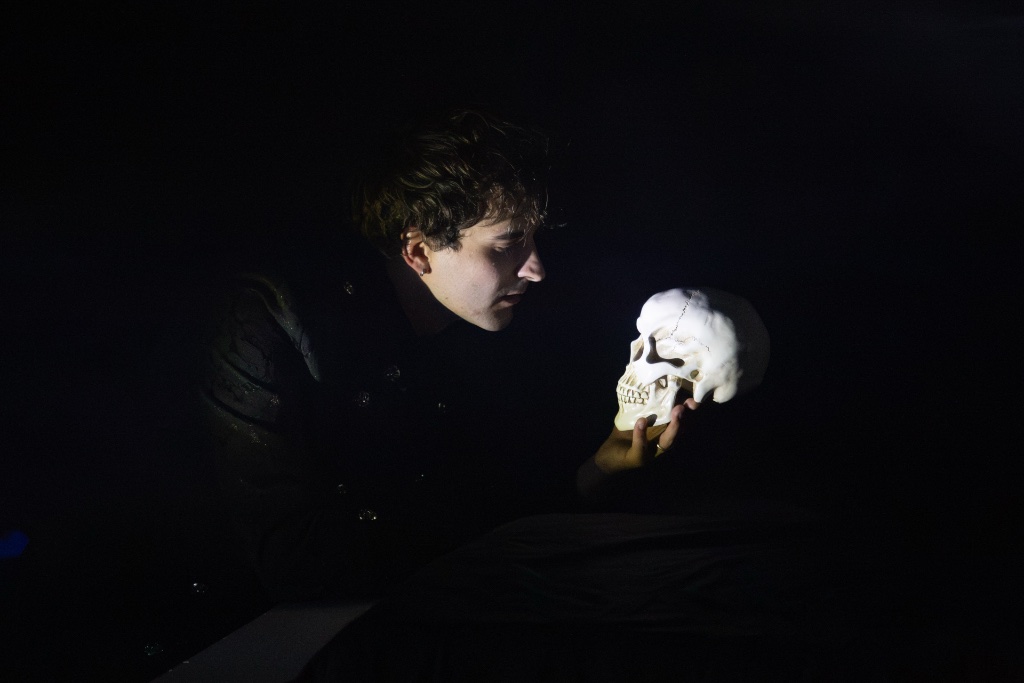
Hamm, played by the extraordinary Victor Duez, is the only actor to appear onstage. Most of the lighting, sound and visual effects are effected by him with a febrile energy and balletic grace. With just a sweep of the hand, his bed at one moment becomes an auditorium where the Shakespeare characters watch a play acted by puppets (all manipulated by Duez) on the headboard-cum-stage, and at another moment is transformed into a grave and gravestone. While all these metamorphoses are taking place, Duez continues to speak with multiple voices, totally in control of his art. It is a virtuoso performance.
Such is the symbiosis between actor and stagecraft, I assumed that Duez must be the creator and director of the play, but in fact it was written by Christophe Luthringer and Ned Grujic and directed by Luthringer. If you can stand a tornado of adolescent angst acted with consummate skill over the course of 75 minutes, I urge you to see this unforgettable show, which was successfully performed at the Festival Off Avignon last summer and will be staged in Paris until the end of March.
Favorite