
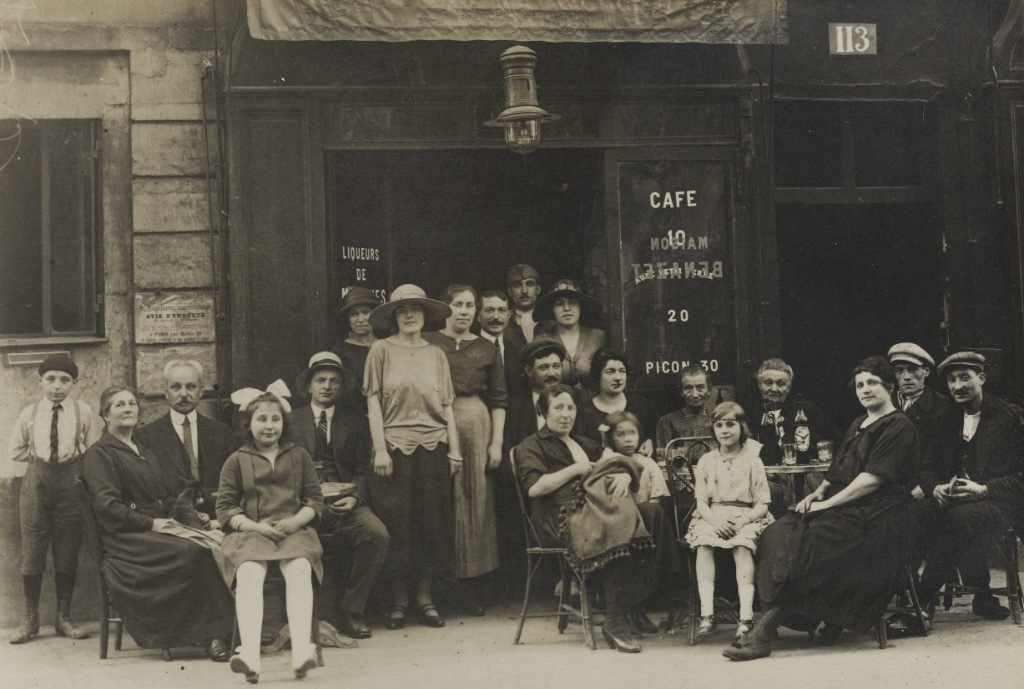
The exhibition “Les Gens de Paris, 1926-1936” at the Musée Carnavalet is not just a snapshot of the people of Paris in the years following World War I and during the Depression, it is a full-scale portrait.

The show presents the results of three unusual censuses taken in the city in the years 1926, ’31 and ’36. They were unusual in that they recorded more than the normal amount of information on every person living in Paris, including the full name, year of birth, place of birth, citizenship, marital status and profession. This was in a period when Paris was at its peak population: in 1921, it had 2.89 million inhabitants, a figure that has never again been reached (the estimated population in January 2025 was just over 2 million).
The resulting goldmine of information about the city’s inhabitants was analyzed for numerous statistical purposes at the time with the help of an advanced mechanical tabulator called the March classifier-counter (one is on display in the show). For the exhibition, information is broken down by place of birth and citizenship, profession, family status and distribution within each district and building within the city.

That may sound dust-dry, but the show brings the Parisian world of the 1920s and ’30s to life with lots of paintings, illustrations, posters, photos, videos, magazine covers, charts, maps and scale models of buildings.
All the texts and labels in the show are translated into English, and they are worth reading for the nuggets of interesting information about the city’s hisotry that many of them reveal. For example, we discover that the Magic City dance hall (formerly an amusement park) on the Quai d’Orsay held a hugely popular transvestite ball, which attracted some 2,500 guests, twice a year. Authorized by the prefecture of police, it was attended by cross-dressers of every description as well as curiosity seekers, gawking at the sight of men dressed as women, women dressed as men, and everything in between. Documented for posterity by the photographer Brassaï, the parade of duchesses and Marlene Dietrichs during the costume contest would have been the envy of Ru Paul.
The police took advantage of the ball to keep a close eye on participants, even though homosexuality was not illegal at the time. They finally shut the ball down in 1934 after pressure from right-wing groups. Plus ça change…

We also learn about the Catherinettes, young unmarried women who donned silly hats and marched through the streets on St. Catherine’s feast day, hoping to attract their dream man. Objective: marriage. It must be remembered that these were the postwar years, when young men were scarce. At the time, 29 percent of Parisians over the age of 15 were single. Until recently, Catherinettes still gathered every year in Montmartre, presumably in tongue-and-cheek fashion.

Visitors may be surprised about how little some things have changed in the past century. One example is provided by an aerial film of Place de l’Étoile (now Place Charles de Gaulle) showing automobiles of the day circling madly around the Arc de Triomphe. It drew a laugh from everyone (including me) who has had the terrifying experience of navigating a car around it.
Naturally, Parisian visitors are especially fascinated by the exhibition, where they can study maps for the location of their forebears’ homes and search census records onscreen to see if they can find their family name, but anyone who loves Paris will enjoy this entertaining exercise in learning about the people of Paris one hundred years ago.
See our list of Current & Upcoming Exhibitions to find out what else is happening in the Paris art world.
Favorite