
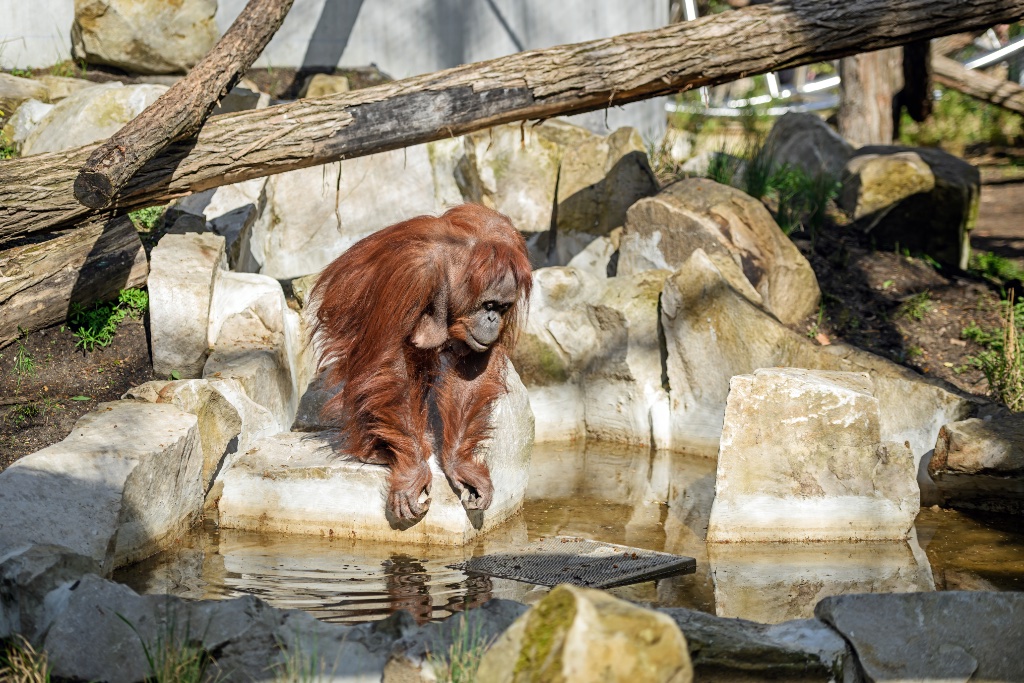
The five orangutans who live in the Ménagerie in Paris’s Jardin des Plantes have a new outdoor playground. Formerly confined to a glassed-in enclosure, they can now make their way across an elevated bridge to a triangular structure entirely enclosed with stainless-steel fencing to prevent escapes as well as intrusions or gifts of forbidden food from visitors.
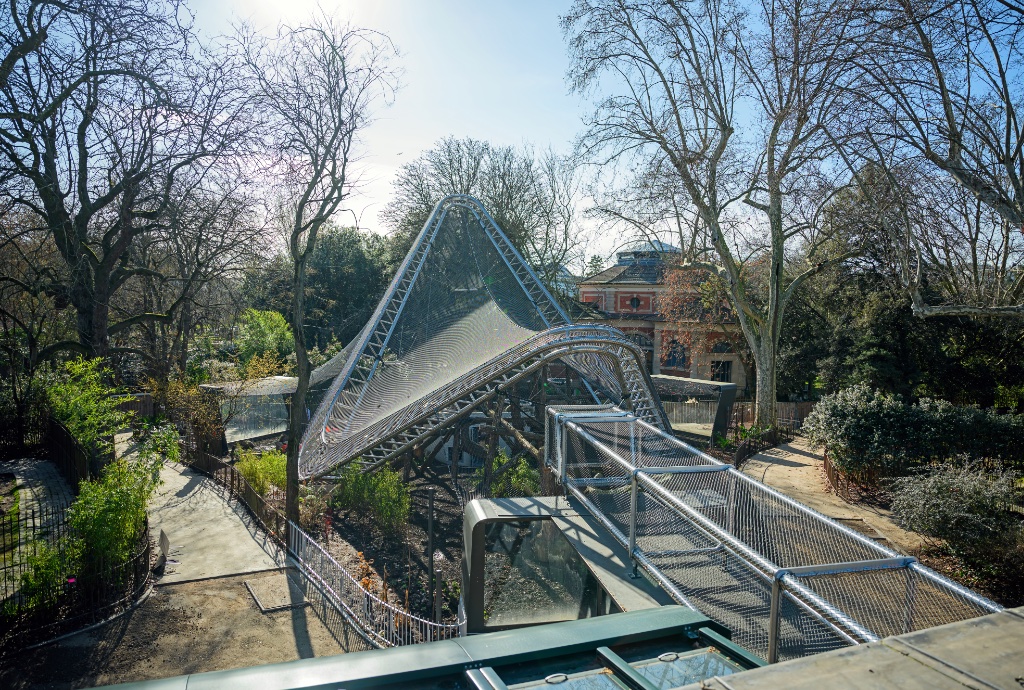
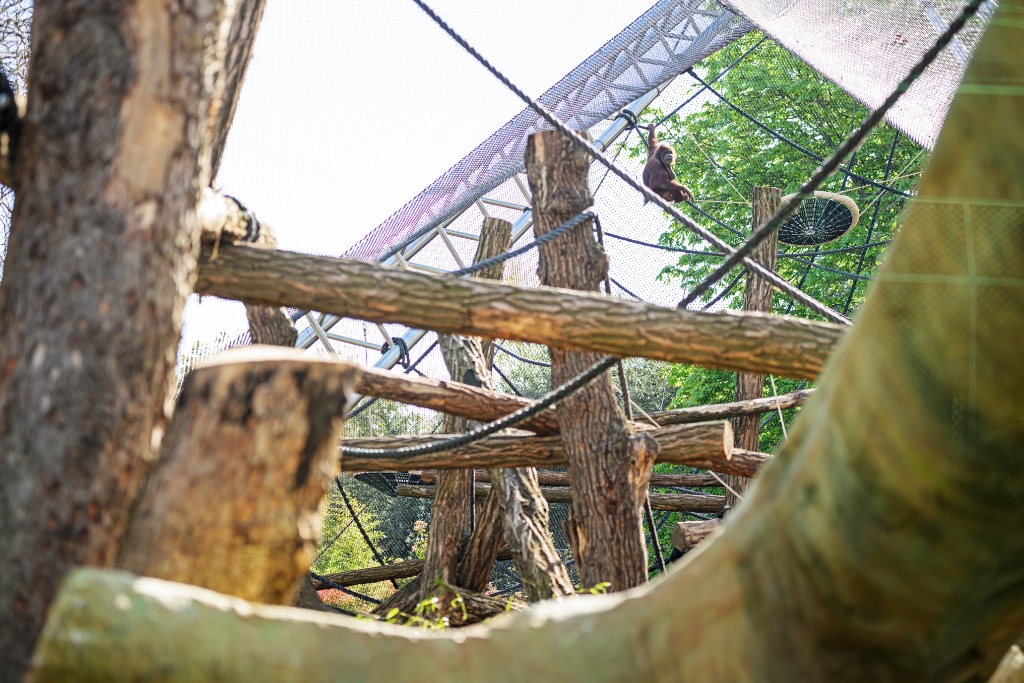
Once they get there, they have plenty of entertainment options: they can swing from the great lengths of rope strung across the space at different levels, lounge in the sun in hanging saucer-shaped baskets or climb 50 feet to the top of a shiny metal structure resembling a roller coaster.
Before the public was allowed in, the animals were given time to get used to their new environment. Christelle Hano, head caretaker, describes their first visit: “Seeing the animals make the space their own was an indescribable feeling. Each of our orangutans has a personality and a way of being that is unique to them. I was amazed to see Nénette, who was immediately at ease, effortlessly climbing up to 15 meters. Tamü quickly followed her, and Théodora explored the structure with curiosity, while Banggi, who is more reserved, took a few days before fully settling into the space.”
Two weeks later, the press was invited to see the new facility. We watched as two females, Nénette and Tamü, left their indoor space in the glassed-in primate building and crossed the bridge to relative freedom.
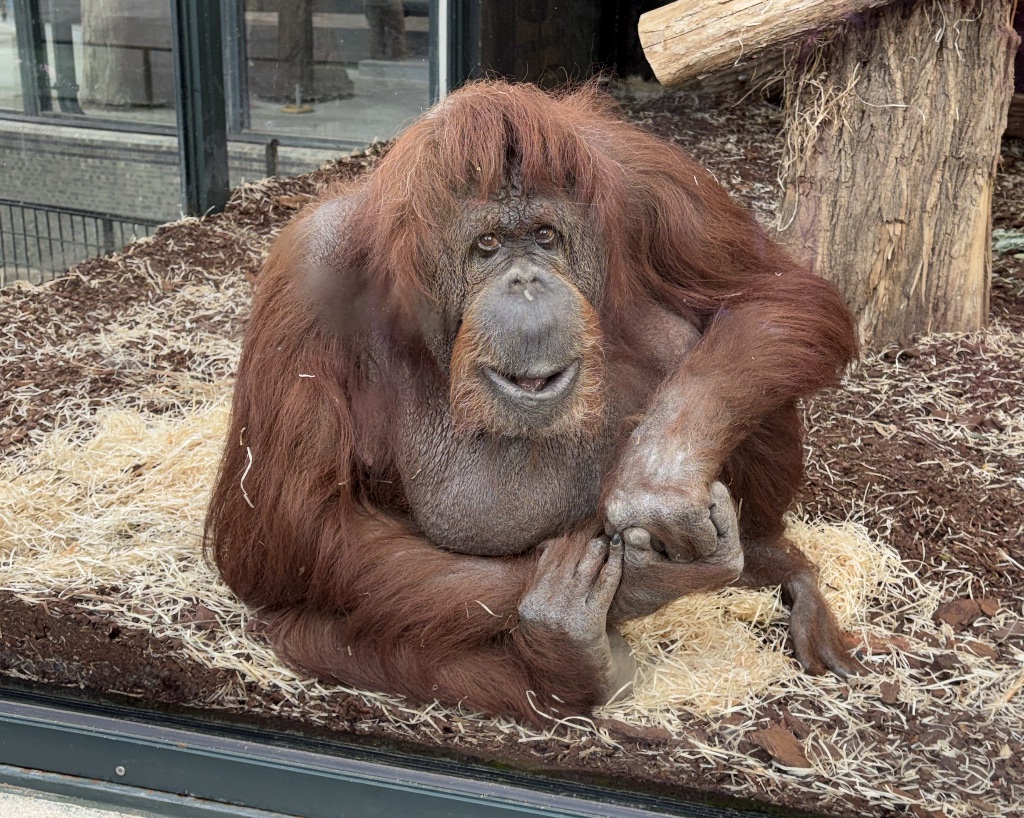
At the age of 56, Nénette is one of the oldest living Bornean orangutans in the world (their lifespan in the wild is 35 to 45 years). According to the zoo’s literature, “Nettie, who arrived in 1972 after having been captured, is one of the last orangutans born in the wild living in a zoo. She is known for her great creativity: she paints every day and spends long periods of time meticulously putting together or dismantling small elements of her environment. A keen observer, she prefers high vantage points and always keeps a watchful eye on what is happening around her.”
The reproductive couple Théodora and Banggi, the proud parents of five-year-old Java, were not introduced to the journalists, but we were told that Java was not yet comfortable with the outdoor space.
The €4 million project, the size of an Olympic swimming pool, was designed by architectural/engineering firm Ney and Partners, specialists in bridges and footbridges, and landscape architects Marboris, in close consultation with zoo officials to be sure that the needs of the orangutans were met and that the structure – the first of its type they had ever built – was strong and appealing to the animals. To re-create a humid atmosphere mimicking that of their native habitat, the structure has six overflow pools and a misting system that can be activated by the orangutans themselves.
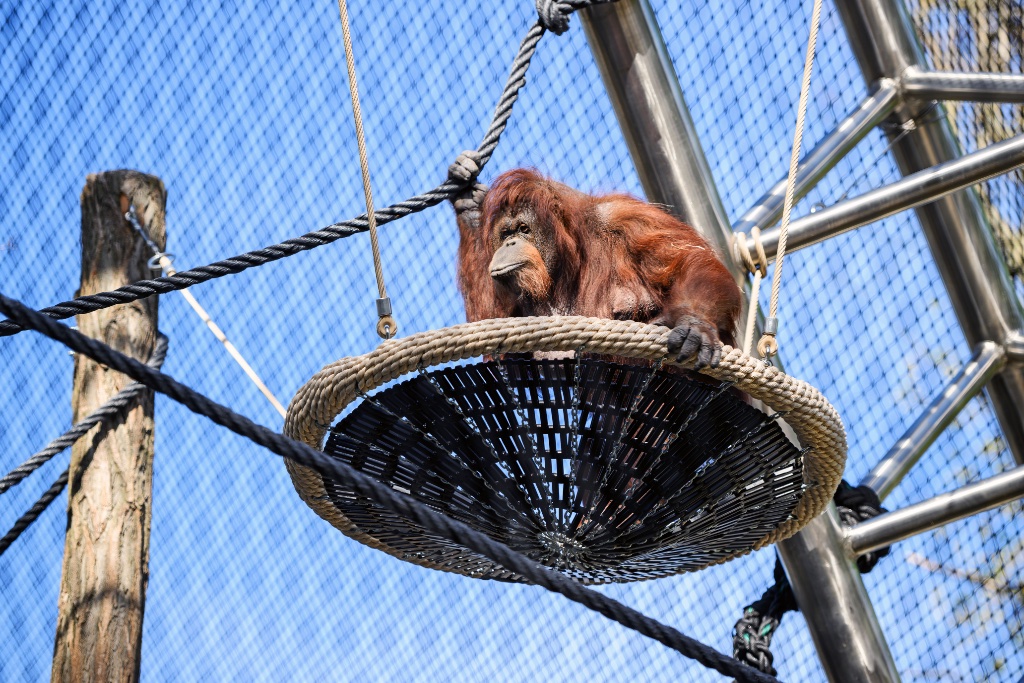
Three viewing platforms offer visitors close proximity and clear views of the orangutans through picture windows. The only danger they will encounter will be falling in love, as I did, with Nénette and Tamü, who are obviously interested in their human cousins. When Nénette was crossing the bridge to go outside, she stopped in the middle to stare down at us journalists for a while, and before the doors opened to let them out, Tamü sat close to the window and carefully studied those of us who came up to take pictures of her while Nénette retreated into the shadows and covered herself with a blanket, which she later carried around with her.
Since the Ménagerie is a historical monument, the entire structure was designed in such a way that it can be removed if need be without damaging any part of the original building or changing the layout of the park.
Like most zoos today, the Ménagerie is committed to providing respectful care and accommodations for its animals, many of which are threatened with extinction in the wild. That is certainly the case with these Bornean orangutans (Pongo pygmaeus), a highly intelligent, tool-using species that is critically endangered in its home environment due to deforestation, illegal trafficking and other forms of human impact. In recent decades, orangutan populations have lost 80 percent of their habitat and have been reduced by half.
There is some hope, however, thanks to on-site protective measures like the foundation of rehabilitation centers and the creation of protected areas, and to off-site international breeding programs, in which the Ménagerie participates. The Paris zoo is also involved in research programs on self-medication among great apes; the assessment of stress and well-being in primates; and theory of mind and cognitive abilities.
The Ménagerie’s scientific and animal care teams are also conducting a behavioral study in collaboration with researchers from the CNRS (the French national research institute) and the National Museum of Natural History. The study will assess the well-being of the orangutans before and after the opening of the new outdoor enclosure, focusing on the diversity and frequency of behaviors exhibited, their use of space and their social interactions. Depending on the results of the study, adjustments can be made to the facility if necessary. Says Aude Bourgeois, director of the Ménagerie and a veterinarian: “This monitoring will allow us to measure the actual impact of the project on the animals’ quality of life, rather than simply assuming it … and to tailor our practices as closely as possible to their needs.”
The world’s third-largest ape, the Bornean orangutan (“man of the forest” in the Malay language) is one of our closest living relatives. We share 96.4 percent of our DNA, which may explain our intense mutual interest in each other. Do pay them a visit.
Favorite