
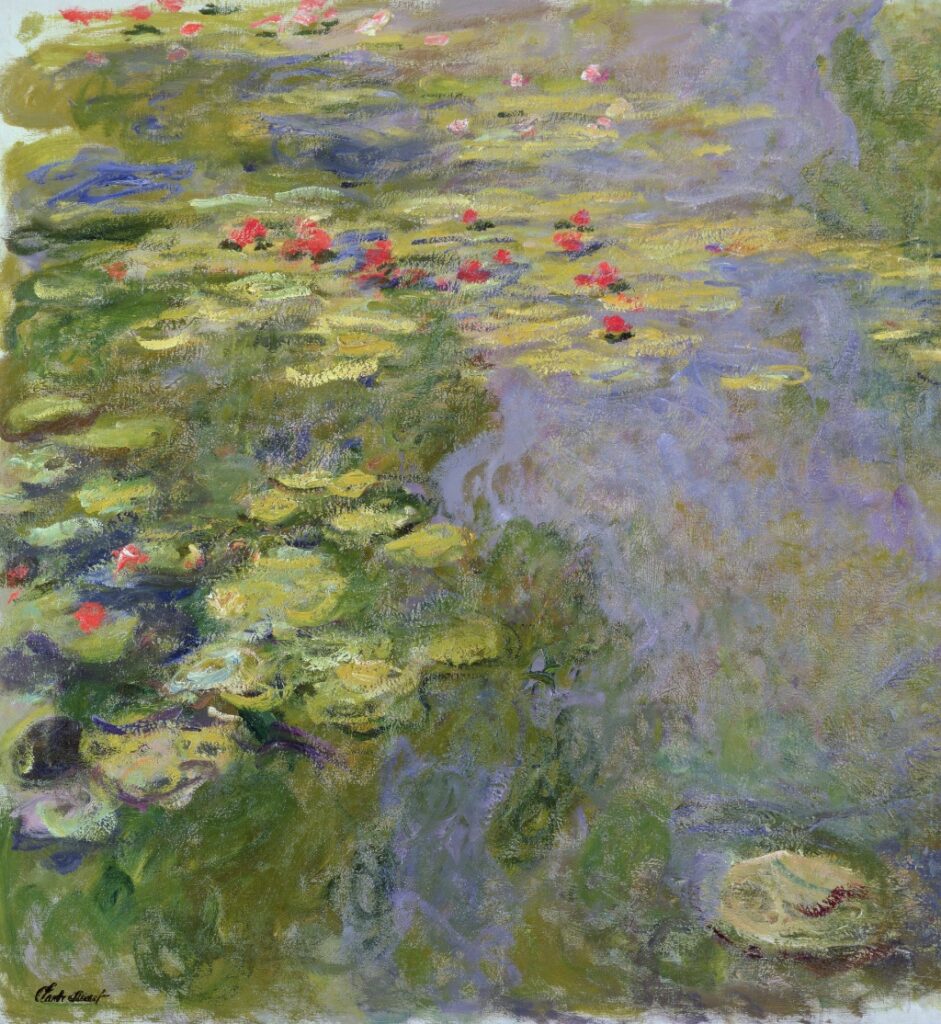
Every year, when the weather turns fine, I take a trip to Yerres, a short train ride from Paris, to see two reliably fine exhibitions and revel in the beauty of the English-style park graced with the handsome former home of the Caillebotte family, plus a tiny chapel, an icehouse, a restaurant and an extensive vegetable and flower garden. On top of all that, the River Yerres runs through the property, along which visitors can paddle in rented rowboats (preferably but not mandatorily dressed in a striped shirt, vest, bowtie and top hat, as in Gustave Caillebotte’s painting ‘The Boating Party”).
This year’s main exhibition, “La Nature N’Est Pas un Décor: De Monet aux Artistes Contemporains,” on the occasion of the centenary of the birth of Claude Monet, takes a few paintings of his garden as a starting point. They are accompanied by landscape paintings by eight contemporary artists whose works have previously been shown at the Maison Caillebotte. While they are in no way imitations of the master’s work, some of them show his influence. “We wanted to see if they could stand up to Monet,” says Valérie Dupont-Aignan, director of the Maison Caillebotte, of the eight painters.
There is also a real-life connection between the Caillebotte estate and Monet, who was a friend of Caillebotte’s. While visiting the property, he took note of a picturesque little bridge in the park, which inspired him to build the famous Japanese footbridge in his storied garden in Giverny.
Like William Turner before him, who is often considered one of his predecessors, Monet was less interested in faithful depictions of landscapes than in the effects of light, a point he has in common with the artists chosen for this exhibition: Jacques Truphémus, Markus Lüpertz, Erik Desmazières, Malgorzata Paszko, Evi Keller, Charlotte de Maupeou, Ronan Barrot and Youcef Korich.
In spite of the variety of their styles, methods and subjects, none of them is interested in simply representing a landscape. What they share, according to the curator, is the special experience – the “Monet effect” – they create as they grapple with bringing nature to the canvas.
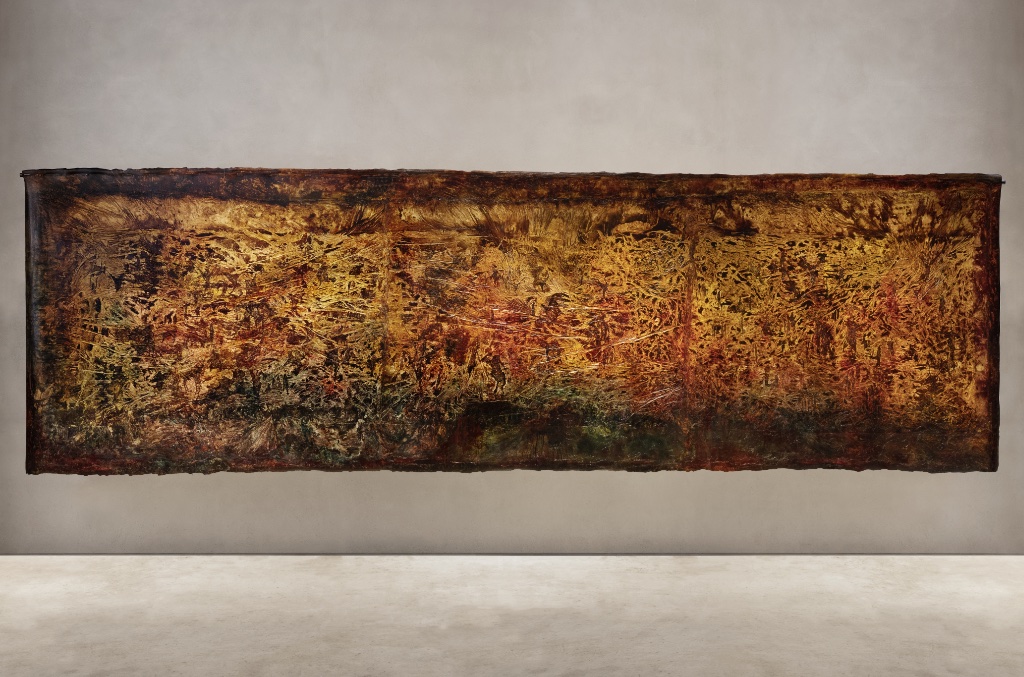
While the connections between them and their relation to Monet’s work sometimes seem spurious, there is much to enjoy in the show as each artist attacks the theme of nature in their own way. Evi Keller, for example, attempts to “materialize light” in her dramatic paintings, using a complex process (described in this article on her show at the Maison Caillebotte last year) to create a layered, cosmic effect.
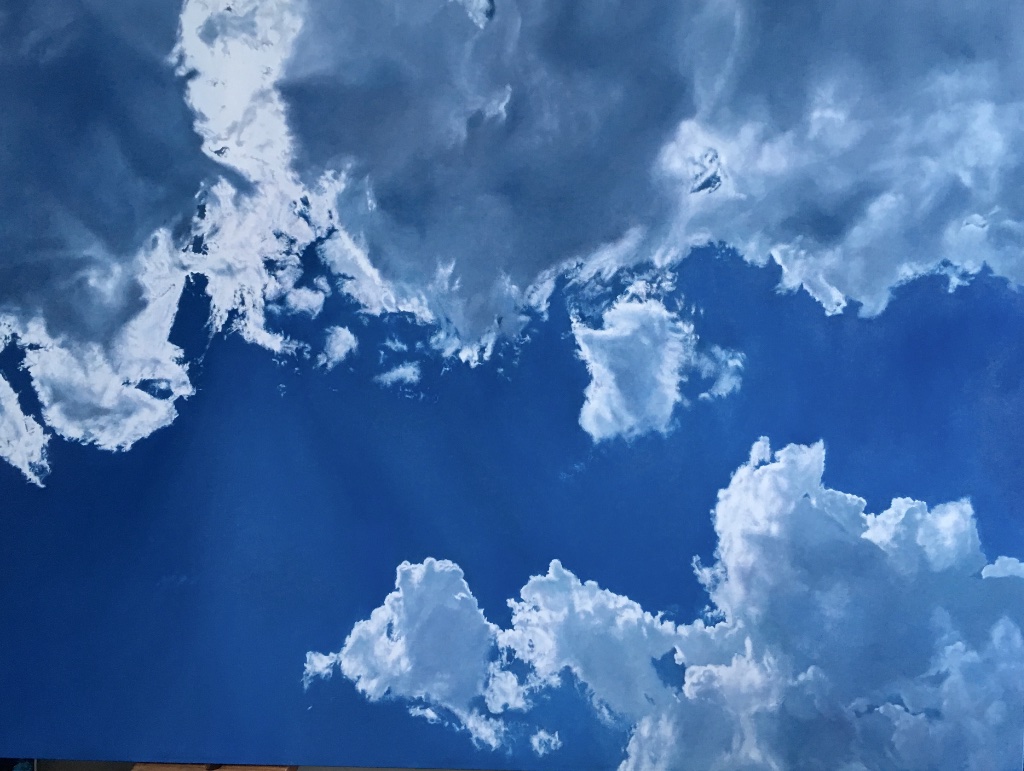
Youcef Korichi focuses on details of nature in his photorealistic paintings of, for example, clouds, tree bark or raindrops falling on an expanse of water as he tries to “subtract the superfluous” and “make the texture of the world perceptible.”
Charlotte de Maupeou literally plunges into nature on her walks through the countryside around her home in the Sarthe department of France, painting sur le motif like Monet but in her own manner, placing the canvas on the ground and letting nature – wind and rain – interfere and contribute to the work as it will. The resulting landscapes are full of charm and color.
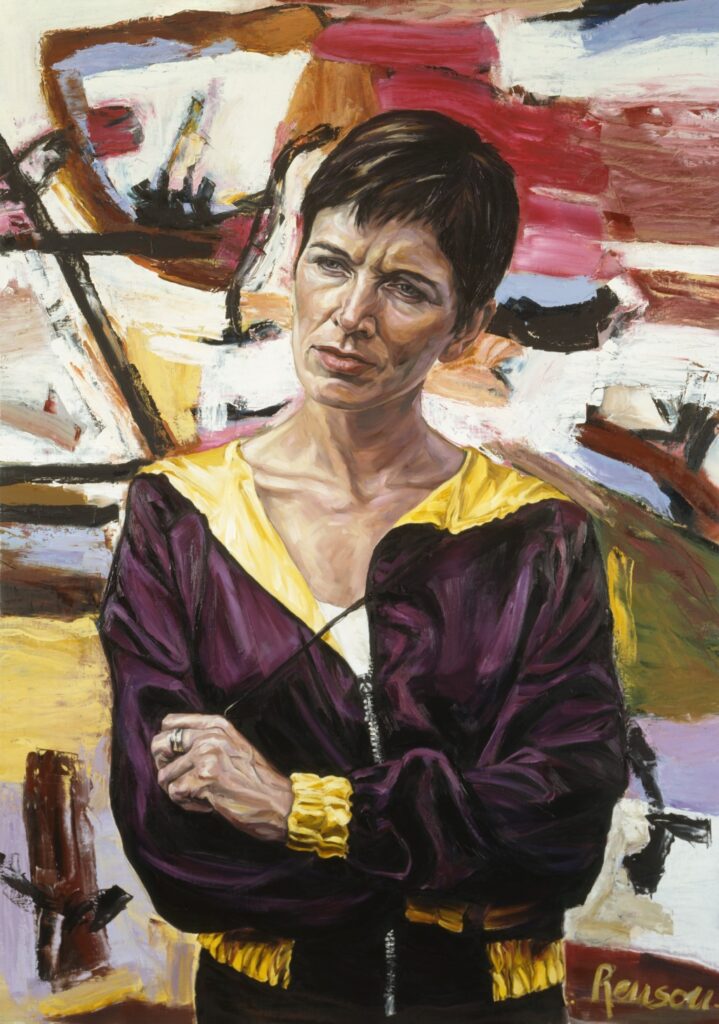
As always, the Maison Caillebotte is holding a second exhibition in the Orangerie, focusing this time on Dominique Renson’s powerfully blunt portraits of herself and her friends.
Art, nature, culture and gastronomy come together beautifully once again at the Maison Caillebotte, a prized destination near Paris.
See our list of Current & Upcoming Exhibitions to find out what else is happening in the Paris art world.
Favorite