
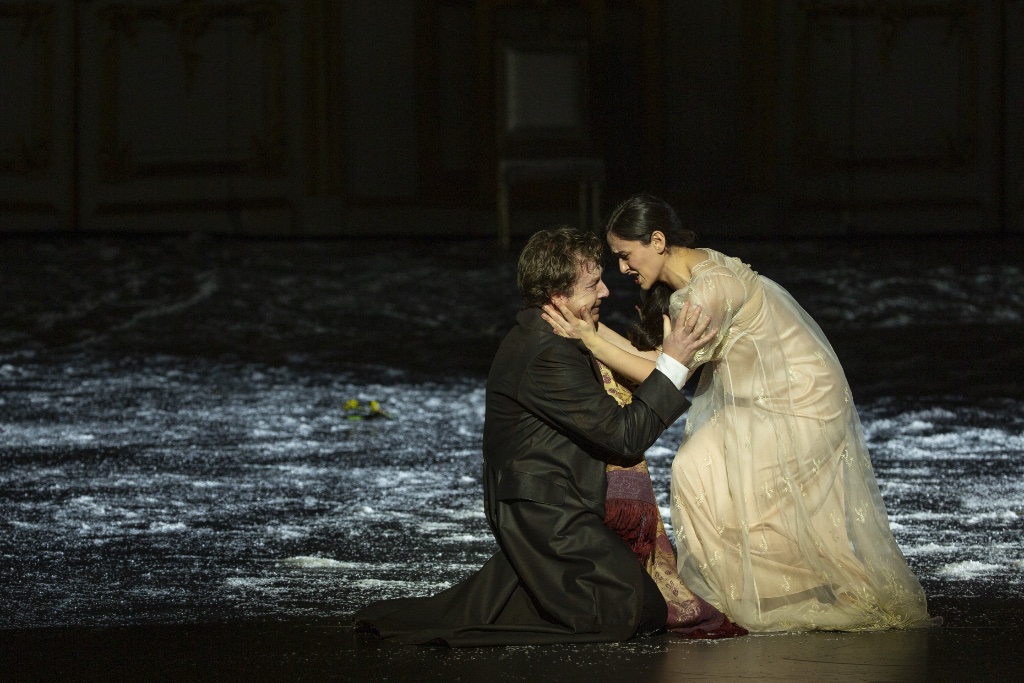
The headline name for this new production of Tchaikovsky’s adaptation of Pushkin’s verse novel Eugene Onegin at the Palais Garnier is evidently Ralph Fiennes in his directorial debut for the Paris Opera. Not only has the much-lauded British actor spoken of loving the novel since his student days, but he also starred in the title role of his sister Martha Fiennes’ 1999 movie Onegin. But there are other notable contributions, not least of them Russian-born conductor Semyon Bychkov’s first production in Paris since he was announced as the forthcoming music director for the Paris Opera.
But first, the production itself. In a city where the more conservative opera-goers love to heckle what they deem to be overly modern reinterpretations of operatic classics, it was telling that there was not a single boo to be heard on the night I attended. Fiennes directs a largely conventional, uncontroversial staging of the piece. That is not to say that it lacks ideas: the way the remote Russian forest dominates the first two acts, with the house in Act I, Scene 2 becoming increasingly hemmed in by the trees but then opening out as the heroine Tatiana gives full rein to her emotions in the famous love letter scene, and the eye-catching group movement and dance throughout (Fiennes is ably assisted here by Michael Levine’s designs, Annemarie Woods’s gorgeous costumes and Sophie Laplane’s inventive choreography) are all visually pleasing. If the production lacks a certain visceral excitement, its feeling of security promises longevity over future reruns, which can only be a good thing, especially considering that Calixto Bieito’s recent production of the first two installments of Wagner’s Ring Cycle at the Bastille Opera is receiving decidedly mixed reviews.
On the musical front, this Eugene Onegin is a triumph. Bychkov (whose exceptional recorded cycle of the Mahler symphonies with the Czech Philharmonic Orchestra is nearing completion) knows the Tchaikovsky score thoroughly, and it shows in his ability to drive the music forward at moments of drama but also to hold back at more intimate moments and allow the music to speak for itself.
As for the singing, it is hard to find fault with anyone. All the central characters in the Pushkin original are young, and it is good to see and hear singers in the earlier stages of their careers. Fiennes and the casting director have succeeded in finding singers who can also act (not always a given in the operatic world!).
Armenian soprano Ruzan Mantashyan is touchingly vulnerable as Tatiana, delivering a stunning letter scene (the elasticity of the speeds she achieves, in tandem with Bychkov, is extraordinary to behold). Tatiana completely dominates Scenes 2 and 3 of Act I, and Mantashyan has the stamina and technique to sustain the drama.
For me, the real star of the show is Ukrainian tenor Bogdan Volkov as the poet Lenski, who loves Tatiana’s sister Olga (pleasingly sung by Maltese mezzo-soprano Marvic Monreal). The way he moves from sunny optimism in Act I to jealous rage and despair in Act II is movingly conveyed, and his showpiece aria is exquisitely delivered, with the most poignant pianissimo singing. Not having heard him before, I noted down that this was a singer of huge promise, only to read subsequently that he was recently named 2025 Singer of the Year by the German magazine Opernwelt. Listen out for his name in the future.
But what of the title character? Eugene Onegin must be one of the most unlikable heroes in opera (and literature). He condescendingly rejects Tatiana in Act I, deliberately flirts and dances with Olga and then kills the jealous Lenski in a duel in Act II, before five years later trying to steal Tatiana from her husband Prince Grémine (beautifully sung by Alexander Tsymbalyuk) in Act III. The Austro-Russian baritone Boris Pinkhasovich has a gorgeously burnished tone to his voice, and he maintains a glowering presence, but he lacks the charm needed to make one understand why Tatiana fell in love with him so quickly. It made me yearn for the charisma of the late-lamented baritone Dmitri Hvorostovsky (who died of brain cancer in 2017 at the age of 55) in the role, or of Ralph Fiennes himself on film.
Mention should also be made of the luxury casting of veteran singers playing some of the supporting roles, such as mezzo-soprano Susan Graham, as Madame Larina, mother of Tatiana and Olga (it’s at moments like these that one notices the brutal passing of time, when a favorite lead singer suddenly becomes a veteran); Elena Zaremba as Tatiana’s nanny Filippyevna; and Peter Bronder as the French singer Monsieur Triquet.
Even though the entire run of this production is sold out, it will be broadcast live on France.tv on Monday, February 9, at 7:30pm French time, and a recording of the opera will be played on the radio station France Musique at 8pm on March 7.