
Given the many constraints that female artists, writers and composers faced in the 17th and 18th centuries, it is a wonder that they managed to create as many completed works as they did. Among all these extraordinary women, composers perhaps had to endure the greatest hardship, as, especially for grand-scale works like opera, it was almost impossible to have their works performed in a very male-dominated profession. This seems to have been the fate of Ercole Amante (1707), the only opera written by Antonia Bembo (c. 1640-c. 1720), as there is no evidence of it ever having been performed.
Thanks to the evangelical zeal of conductor Leonardo Garcia-Alarcón, this impressive five-act opera has been rediscovered and performed in Paris for the first time at the Opéra de Paris, Bastille. Even if the composer’s name and the Italian title of the opera might seem to have little relevance to France, in fact, after fleeing Venice to escape her violent husband, Antonia Bembo was presented in Paris in 1677 to Louis XIV, who granted her a royal pension. Thus it was in France that this story about the declining years of the mythological warrior Hercules, to whom Louis was often compared, came to be written at a time that the aging French king’s reign was in its final years.
Strangely enough, Bembo set her opera to exactly the same libretto by Francesco Buti that 45 years earlier her teacher Francesco Cavalli had used in writing an opera to celebrate the young Louis’ marriage in 1662. She seems to have been paying tribute to the memory of Cavalli and perhaps also trying to catch the attention of the king in the hope that he would support the production. Or, as Garcia-Alarcón suggests, she may even have been commissioned to write the opera by the monarch. However, unlike in 1662, only operas with a French text were in vogue in the early years of 18th-century Paris, so Bembo’s choice of an Italian libretto might have made it seem decidedly out of fashion.
Whatever the circumstances, the musical language of Bembo’s version differs from the Italianate style of Cavalli and from the many French imitators of Lully, who had been Louis XIV’s court composer, by mingling French and Italian elements. As Garcia-Alarcón writes in the program notes, “Her music combines the French tradition of harmonic richness with the Italian tradition of great rhythmic complexity, creating a new style.”
British director Netia Jones, who recently became associate director of the Royal Opera House in London, has created a glorious production, weaving together both modern and ancient worlds, with sumptuous use of video and physical backdrops to evoke the many locations used over the course of the opera, such as royal palaces, a tower in the middle of the sea and even hell.
Statues of the young and all-powerful Hercules serve as a strong visual reminder of his current decline. Here he is a seedy, entitled, overweight leader (performed with relish by the appropriately named bass-baritone Andreas Wolf) who sees it as his right to expect the young, beautiful Iole (excellently acted and sung by soprano Ana Vieira Leite) to succumb to his sexual advances, regardless of the fact that she is engaged to his own son Hyllo (Alasdair Kent, who sings the high tenor role with touching vulnerability). Just in case we have missed the obvious modern parallels, at one point Hercules is served a platter of Big Macs and fries by his valets.
As this is a world where gods and humans mingle, we have interventions by the goddesses Venus (soprano Sandrine Piau), who has the ungrateful role of backing up Hercules’ transgressions, and Juno (feistily played by soprano Julie Fuchs), who supports the two young lovers and vigorously opposes Hercules. Mezzo-soprano Deepa Johnny sings the role of Hercules’ long-suffering and neglected wife Dejanira. Thrown into the mix are comic servant roles Lico (tenor Marcel Beekman, who gets to sing in some beautifully rendered trios with the main characters) and Paggio (counter-tenor Théo Imart, who is given a Puck-like role in this production).
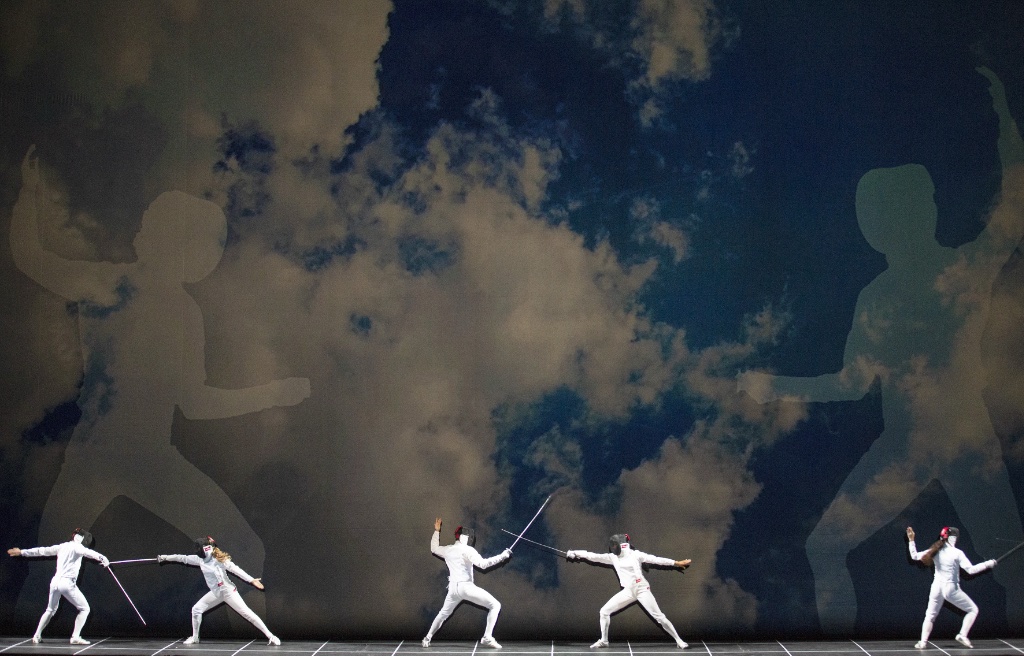
As in all French operas from this time, ballet and dance play an integral part, and here Netia Jones and choreographer Maud Le Pladec cast the dancers in various guises as Olympic athletes (fencers and runners feature prominently), giving a high-energy rush to the instrumental interludes. Antonia Bembo also assigns some substantial pieces to the chorus, thrillingly sung in this production by the Chorus of the Chambre de Namur.
Garcia-Alarcón conducts with huge energy and belief in the greatness of Bembo’s music, and the musicians of Cappella Mediterranea respond to him with brilliance and verve. Just the one hearing of the piece (it is yet to be recorded) does not allow me to make a full assessment of the music’s qualities, but my initial response was awe at the extraordinary skill and proficiency of Bembo in creating such a theatrical and musical world, but perhaps I had hoped for a few more knock-out arias that make you hum the tune as you walk out of the Bastille Opera House.
I can’t wait to have the chance to hear and see it again, as it is sure to become a part of the operatic repertoire. In the meantime, do go and see this excellent production if you are in Paris during its run.
Note: Ercole Amante will be shown live on Arte.tv on June 9, 2026, and later on Arte and on POP–Paris Opera Play.
Favorite
What a very exciting opera!! And your descriptions and comments are really rather illuminating and make us want to see it. Very well done, Nick!!